How to Turn First-Time Donors Into Repeat Donors (Without Begging)
- Introducing AI-Powered Donor Research Profiles
- How to Turn First-Time Donors Into Repeat Donors (Without Begging)
- How to Know When (and Whether) to Apply for a Grant
- Stop Rebuilding the Same Reports | Roadmap Review April 2026
- Best Nonprofit Accounting Software: A Complete Guide
- Introducing the New Advanced Relationship Search in MonkeyPod
- 7 Steps to Launching an Effective Matching Gift Campaign
- Making a Data Management Plan: The Importance of Clean Data
- Data Transparency–The Secret to Unlocking Your Team's Potential
- How to Start a Nonprofit–A Checklist for New Organizations
- Unlock More Matching Gift Revenue with Less Effort: MonkeyPod + Double the Donation
- Automate Your Payroll With MonkeyPod and Gusto
You worked hard to get that first gift. Someone found your organization, connected with your mission, and decided to give. That's no small thing.
Now comes the harder part. How do you turn a single gift into lasting impact for your organization?
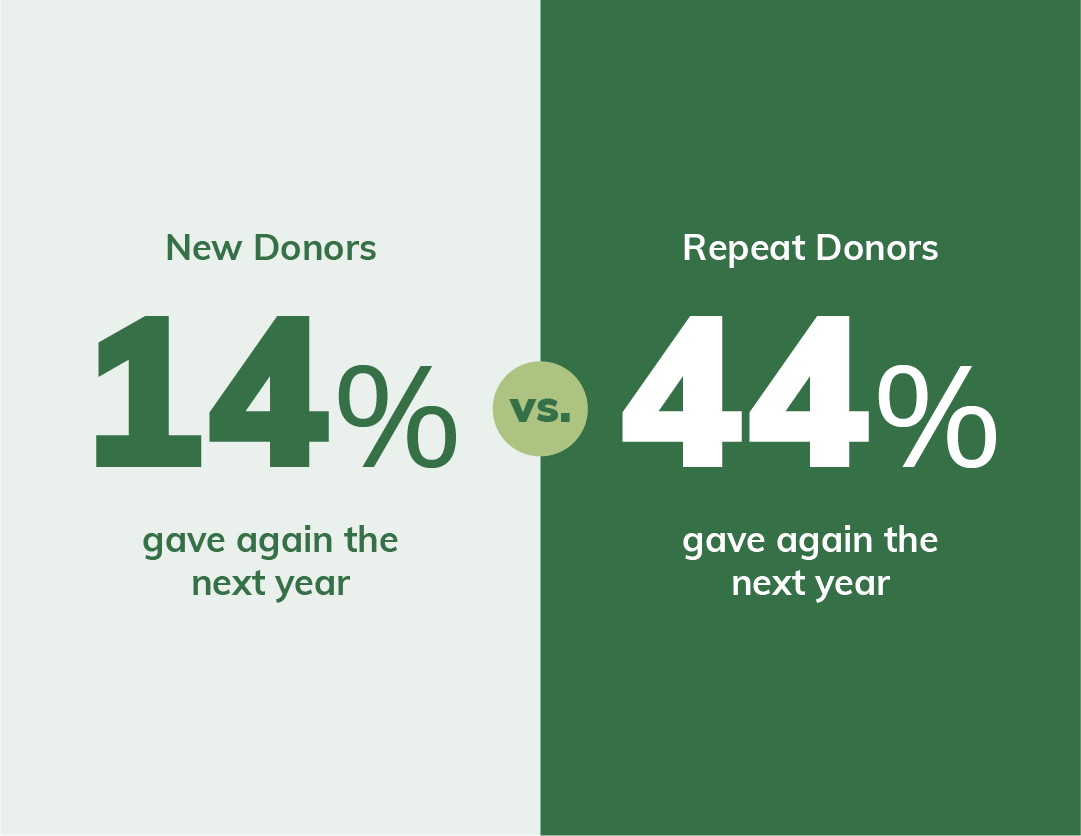
According to the Fundraising Effectiveness Project, only 14% of new donors from 2024 were retained in 2025. That means most donors just quietly disappear — not because they stopped caring about your cause, but because no one gave them a reason to stay.
The encouraging flip side: donors who do give a second time are far more likely to keep giving. 43.6% of repeat donors were retained from 2024 to 2025, with over 60% of total giving in 2025 coming from those retained repeat donors. That shows just how important that second gift is. It's the moment a donor crosses from "someone who gave once" to "someone who's part of your community."
So how do you get there? Not by asking more, but by investing more in the relationship.
The 90-day window matters more than you think
The best time to cultivate — not ask for — a second gift is in the first 90 days after the initial donation. Donor psychology follows a predictable arc: emotional engagement peaks immediately after the gift, curiosity about outcomes builds through 30–90 days, and then? Gradual drift — unless something pulls them back in.
This 90-day "honeymoon period" is your window. Use it to show donors that their money was well-spent, that they're valued, and that your organization is worth staying connected to. Make sure you show them before you ask them again.
Here's how.
1. Make a lasting impression with your thank-you
A heartfelt, personalized thank-you is the foundation of everything else. And timing matters: according to Guiderstar, research consistently shows that donors who receive a personal thank-you within 48 hours of their gift are four times more likely to give a second time.
That's not a small number – a 400% improvement in renewal rates if you get that thank you out in 48 hours.
A generic auto-receipt with a thank-you is important (and MonkeyPod takes care of these automatically) but that’s not what we mean here. A real thank-you acknowledges the person, references what they gave, and tells them (briefly, genuinely) what it means. It doesn't need to be long, but in our disconnected, AI-influenced world, it does need to feel human.
MonkeyPod makes it easy to identify first-time donors and track every touchpoint in your stewardship workflow. With built-in pipelines and action items, your team can stay on top of personal outreach without things slipping through the cracks — even if you're a team of two.
2. Send short, frequent impact updates — not long newsletters
Here's a mistake a lot of nonprofits make: they send one big, comprehensive newsletter every month or quarter and assume that counts as staying in touch. It doesn't.
Nobody wants to read a newsletter that could double as a research paper. Donors are reading on their phones, skimming subject lines, and making split-second decisions about what to open. A long email sent infrequently is easy to miss, easier to skim, and almost certain to be forgotten.
The data backs this up. Industry email benchmarks show that the average open rate for emails sent by nonprofits is 25.2%. If you’re pouring all your energy into sending one email a month, you’re putting all your eggs in one basket, and only a quarter of recipients are going to open it, let alone read to the end.
Think short and sweet instead. Each email should have one purpose and, ideally, one call to action. More frequent, more focused communications mean more meaningful touchpoints with your donors — and it shows respect for their time. An email that takes 90 seconds to read and makes someone feel something? That's worth more than four pages of program updates.

Think about that open rate data as well. If you send four emails that each have a 25% chance of being opened, the odds of someone at least getting part of your message are much greater than if you just send one email.
Pro tip: Your first-time donors should receive a short impact email around the 30-day mark. Don’t send a solicitation, just a genuine update. "Here's what your gift helped make possible." Again, think short and sweet – three paragraphs and a link to your website if they want to learn more.
Building this outreach program is easy with MonkeyPod. Because your email outreach tool is fully integrated with your donor data, you don't have to export lists or sync spreadsheets to send targeted, personalized outreach. You can build automated email sequences triggered by donor behavior — a welcome series for first-time givers, a three-month impact update, a soft re-engagement nudge — and set them up once.
Because email is built into the same system as your CRM, every open, click, and interaction shows up right inside each donor's record. You always know where you stand with a constituent.
3. Celebrate your donors publicly
With permission, give your donors a shout-out on social media. Public recognition deepens their sense of connection and belonging. And when a donor shares your post or tags their friends, you've just expanded your reach for free.
Consider a recurring "Donor Spotlight" or "Impact Story" feature. Tag their personal or business accounts where appropriate. Keep the tone warm, grateful, and specific to them — not a template with their name swapped in.
The goal here isn't marketing. It's making someone feel like a member of the community you're building.
4. Give them a seat at the table
Donors who feel connected to your work, not just your cause, stay donors longer. That means going beyond impact emails and inviting them into the organization itself.
Exclusive event invitations, behind-the-scenes tours, early-bird ticket pricing, first-access volunteer opportunities — these experiences signal that donors are insiders, not just names on a list. A donor survey asking for their input on community needs or programming is another powerful touch: it says your perspective matters here.
Make sure you capture this in your CRM as well. Keeping track of ticket sales and RSVPs, volunteer hours, and more helps you build a more complete picture of your donor. You can use that information to further personalize your outreach. If you know some donors love to attend your events, you can put them on a VIP list so they get first dibs on tickets. Just like with emails, MonkeyPod can capture all this data, so you can build a comprehensive record of each relationship you build.
5. Build a membership program
One of the most effective ways to shift donors from one-time givers to lasting advocates is giving them a structure to belong to. Membership programs — with tiers, perks, and recognition — move the relationship from "transaction" to "identity." When someone calls themselves a member of your organization, they're not just a donor anymore. They're part of the team.
Consider tiered levels based on giving amounts or frequency. Offer meaningful perks at each level — not just tchotchkes, but things that deepen connection: early access, invitations, recognition, or impact updates that only members receive.
MonkeyPod's Member HQ app lets you manage your entire membership program in one place: create tiers, accept monthly or annual recurring gifts, and use Smart Email Lists that automatically update as members join, lapse, or upgrade. No manual list management. No wondering who's still active.
The mindset shift that makes all of this work
Sustainable funding is a challenge for every nonprofit. But with every new donor, you have an opportunity to build a relationship that helps sustain your organization and deepen your connection with your community. Remember that the time to start building that relationship isn’t during the end of year fund drive. It starts the moment they appear in your database.
A donation is not a completed transaction. It’s the beginning of something. Treat your donors with that mindset from day one, and the second gift (and the third, and fourth, and the tenth) tends to follow.
If you want to see how MonkeyPod can help your organization build stronger donor relationships (and save time doing it), we'd love to show you around. Schedule a free demo with our team of nonprofit veterans today.