How to Know When (and Whether) to Apply for a Grant
- How to Turn First-Time Donors Into Repeat Donors (Without Begging)
- How to Know When (and Whether) to Apply for a Grant
- Stop Rebuilding the Same Reports | Roadmap Review April 2026
- Best Nonprofit Accounting Software: A Complete Guide
- Introducing the New Advanced Relationship Search in MonkeyPod
- 7 Steps to Launching an Effective Matching Gift Campaign
- Making a Data Management Plan: The Importance of Clean Data
- Data Transparency–The Secret to Unlocking Your Team's Potential
- How to Start a Nonprofit–A Checklist for New Organizations
- Unlock More Matching Gift Revenue with Less Effort: MonkeyPod + Double the Donation
- Automate Your Payroll With MonkeyPod and Gusto
- From Students to Donors: Cultivating Long-term Relationships with your Constituents
There's a moment that almost every nonprofit leader knows: you hear about a foundation with a hefty grant available, someone forwards you the link, and suddenly everyone's excited.
But now you have a decision to make: To apply? Or not to apply? That is the question.
Any grant application takes time and energy, and when you have a small staff, it's important to have a process for determining if a grant is worth applying for. Not having a process can result in wasted hours, demoralized staff, and a reputation with funders that can be surprisingly hard to rebuild.
Grant funding can be transformational for your organization. But it works best as part of a diversified revenue mix, not as your sole lifeline. And getting good at grant management means getting good at evaluating grant opportunities.
In this article, we'll walk you through a framework you can use to determine whether you should apply for a grant.

Before you write a single word: the go/no-go question
Most organizations jump straight into writing applications. The smarter move is to build a systematic process for deciding whether to apply at all.
Here's a framework built around ten criteria. Think of it as a checklist you run before you commit time and energy to a new application.
1. Alignment. Does your work genuinely fit the funder's mission, values, and strategic priorities? This is the most important question. Read their website carefully — the language they use is intentional, and you'll want to mirror it back to them in your application.
2. Demonstrated need. Can you document an unmet community need that your work addresses? Funders want evidence, not just claims. This means gathering your activity metrics, program data, and community feedback before you're staring down a deadline.
3. Funding history. What have they actually funded before? Look at past grantees. Are they organizations of similar size and scope to yours? Is the grant opportunity the right size for your organization? A nonprofit with an annual budget of $600,000 should think twice before applying for a grant of $10 million.
4. Invitation. Some funders are invitation-only. If that's the case, have you been invited, or do you need to start by building a relationship with the funder?
5. Expertise. Does your team have the capacity to do the proposed work? If not, do you have a credible plan to build it?
6. Relationship. Do you have any contact with the funder? Even a warm introduction or an attended info session matters. Funders don't want to wade through stacks of misaligned applications. Most of them are happy to tell you early on whether you're a good fit as it saves both your organization and the funder time.
7. Timeline. Do you have enough time to put together a competitive proposal? If you've done this before, you can move faster. If this is your first application, build in extra cushion. Be honest with yourself about what "enough time" actually means, a rushed application is probably not a good use of your limited resources.
8. ROI. Does the size of the award justify the effort to apply and the reporting requirements on the back end? A $20,000 grant with a 100-hour application and onerous quarterly reporting may not pencil out, especially for a lean team.
9. Reporting requirements. What does compliance look like after you win? This is often underestimated. If you're not confident your organization can meet the ongoing reporting burden, that's a real risk, both to the relationship and potentially to the funding itself.
10. Odds. How many grants are being awarded, and to how many applicants? If you can find this information (either online or by asking the funder directly), it'll give you a grounded sense of whether this is worth the investment.
If eight or more of these are solid green, you've got a strong case to proceed. If you're hitting three or four no's, it's usually better to move on for now. You can always spend time building a relationship with that funder and applying in the next cycle.
Build your library before you need it
One of the best investments you can make in your grant program is creating a materials library before you're racing to hit a deadline.
You'll reuse more than you think — your mission statement, organizational history, board member bios, your most recent 990, your needs assessment language. The first time you write any of these, it's slow. The tenth time, you're doing a quick update and pulling pieces off a shelf.
That said, you should never submit the same boilerplate to every funder. Think of it like a tailored cover letter. The foundation is reusable; the framing, language, and emphasis should reflect how this particular funder talks about the work they care about.
Relationships are the long game
The most experienced grant professionals will tell you the same thing: relationships matter. More than you may think.
Funders are much more likely to fund organizations they know and trust. Program officers can tell you early on whether your work is a fit. They can give you feedback on a draft. If they move to a new foundation, that relationship moves with them, and potentially opens new doors.
This means building relationships before you need them. Attend info sessions, ask thoughtful questions, stay in touch after a grant or proposal cycle ends. If your organization wins a grant and you go silent until the next renewal cycle, you've missed the most important window to build a genuine partnership.
After you win, communicate proactively. If your budget is going to shift, let them know before they see it in a report. Share your outcomes. Invite their feedback. The organizations that turn one grant into a long-term funding relationship are the ones that treat their funders as partners, not ATMs.
The data you'll need — and when to start collecting it
Grant applications live and die on evidence. Not vague assertions, but specific, documented proof that your work is addressing a real need and generating real impact.
The time to build that evidence base is not the week before your application is due, it's right now. Track your program data in real time, that way it's easy to generate a report when the time comes. You can track things like:
- How many people you serve
- How many people you had to turn away due to limited capacity
- Volunteer hours
- Outcomes from surveys, observations, or other methods of collecting data
You can also capture qualitative stories from participants. Both quantitative and qualitative data matter: numbers show scale, stories show meaning.
If you're currently running an afterschool program with 35 students and turned away 115 applicants due to capacity, that gap is your most powerful grant argument. But you can't tell that story if you don't have the data
Track your data and prepare your proposals all in one place
Keeping all of this organized — funder research, application timelines, team assignments, outcomes data, and budget tracking — is genuinely hard to do without the right system. Sticky notes and scattered calendar reminders have a way of turning grant management into a source of stress rather than a growth strategy.
Helping nonprofits organize their grant strategy is one of the key things MonkeyPod was designed to do. You can use MonkeyPod's CRM functionality to keep track of funder communication as you build relationships. You can also track and report on those activity metrics like the number of people served and volunteer hours.
When you're ready to apply, that's where MonkeyPod's Grant Tracker app comes in. You can use this tool to keep track of all your proposals, create and assign action items for individual assets (your letter of inquiry, budget, etc.), and keep track of your proposal success rate. Because all your proposals live in one place, it's easy for the whole team to stay on the same page, and for you to identify opportunities to reuse assets.
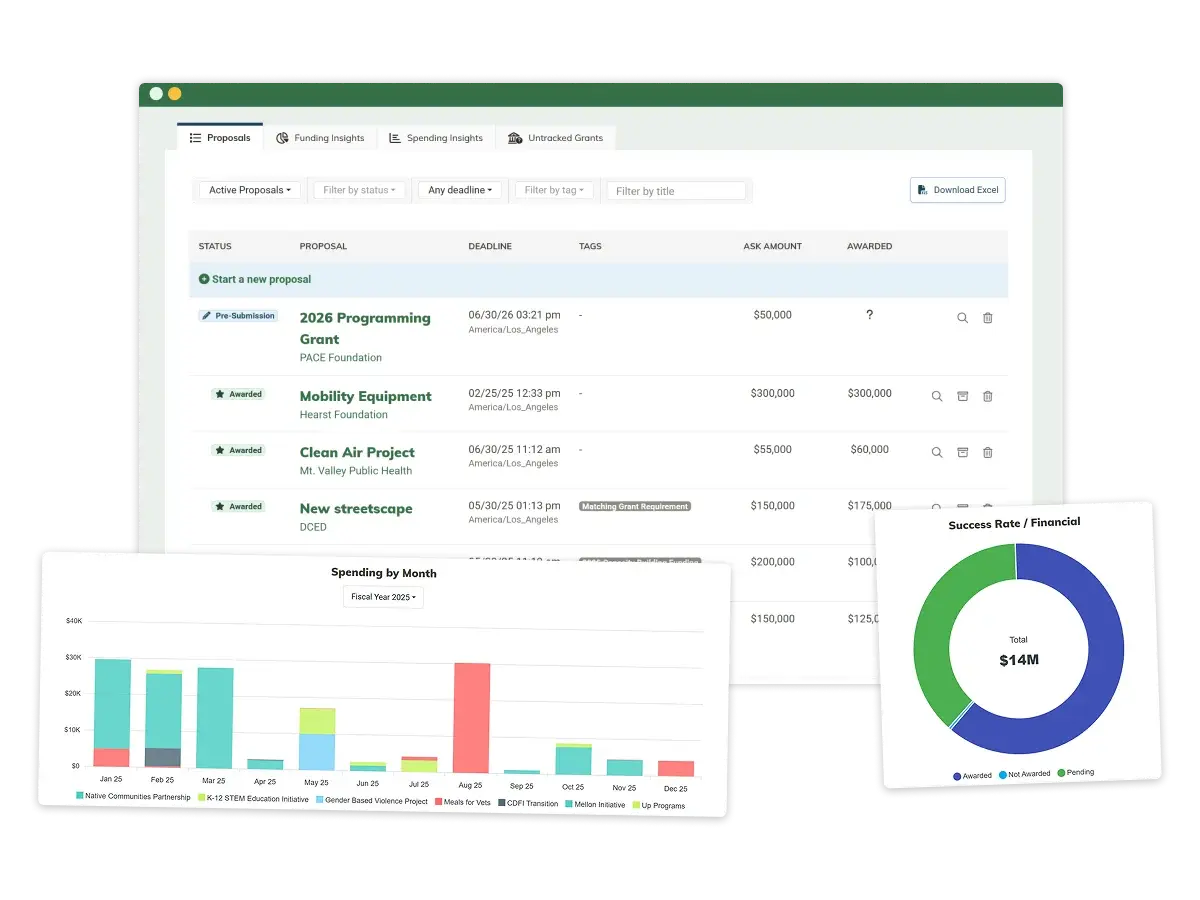
And since MonkeyPod is also your accounting platform, it can make post-award grant management easy too. Tracking restricted fund balances, monitoring budget vs. actuals in real time, and exporting clean financial reports for your funder are all things you can do without switching tools or reconciling spreadsheets.
If you're building toward a more serious grant program, that kind of organizational infrastructure isn't overhead. It's what makes the difference between a one-time grant and a long-term funder relationship. Whether you're using MonkeyPod or other grant management tools, it's worth investing in.
The bottom line
Not every grant is worth pursuing. The organizations that excel in grant management are the ones that get good at evaluating opportunities quickly, build repeatable processes, and invest in the relationships that lead to sustained funding over time.
Start small if you're new to this. Build your materials library. Document the needs of your community and how you’re addressing them before the application is due. And treat every funder as a potential long-term partner — because the best ones are.
If you'd like to see how MonkeyPod can help streamline your grant management process, schedule a demo. Our team has applied for our fair share of grants, and we'd love to share more tips and tricks with you.